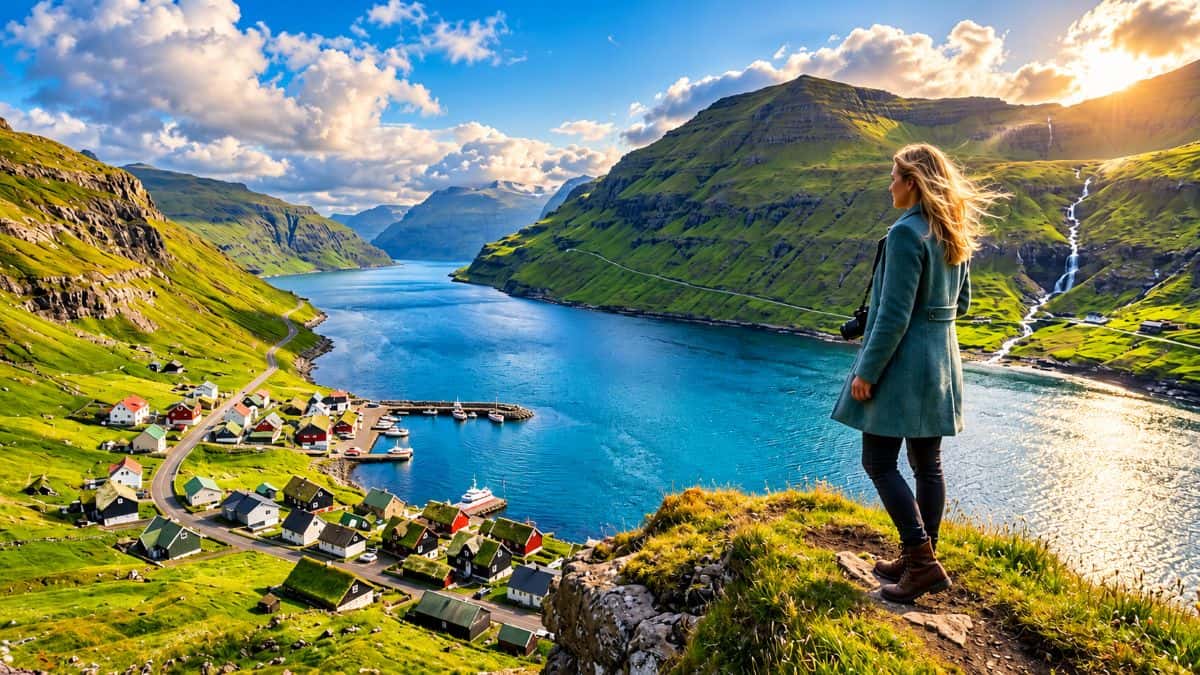
The Faroe Islands rise from the North Atlantic halfway between Norway and Iceland, an archipelago of eighteen steep, treeless islands. Irish monks seeking solitude are believed to have been the first settlers, perhaps in the sixth or seventh century, and recent archaeological evidence suggests people may have arrived even earlier. Their stay was overtaken by the arrival of Norse settlers in the ninth century, who gave the islands their name, meaning 'Sheep Islands'.
The Norse settlers farmed, fished and governed themselves through the Løgting, an assembly that met on the rocky headland of Tinganes in Tórshavn. It is considered one of the oldest parliaments in the world. Christianity arrived around the year 1000, and the islands came under Norwegian rule. At Kirkjubøur, the ruins of the medieval Magnus Cathedral and an ancient wooden farmhouse still recall this era.
Read the full history
When Norway entered a union with Denmark in the fourteenth century, the Faroes followed, and they remained under Danish control after Norway left that union in 1814. For centuries a royal trade monopoly controlled commerce, and life revolved around sheep farming and fishing in open boats. In the nineteenth century the monopoly ended, deep-sea fishing grew and a national movement revived the Faroese language and its ballad traditions. During the Second World War, while Denmark was occupied, British forces garrisoned the islands.
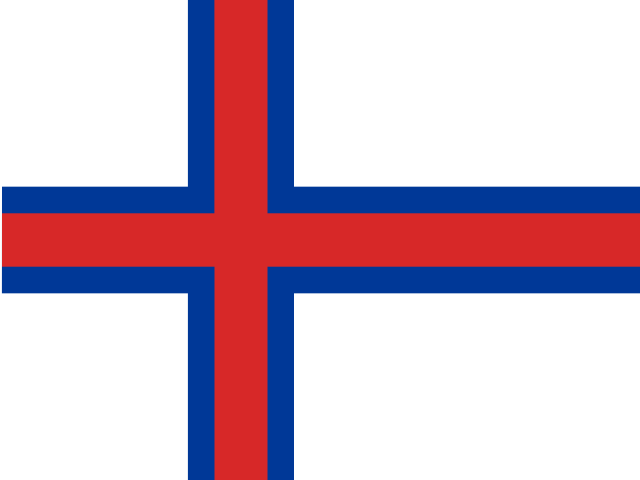
In 1948 the Faroes gained home rule as a self-governing nation within the Kingdom of Denmark, with their own flag, parliament and language. They chose not to join the European Union. Today fishing and salmon farming drive the economy, and tunnels, including undersea ones, link many of the islands. Visitors come for dramatic cliffs, grass-roofed villages, puffin colonies, chain dances and a culture that has stayed remarkably distinct in its remote corner of the ocean.
Timeline
c. 6th–7th centuryIrish monks are believed to settle the islands
c. 800sNorse settlers arrive and establish farms
c. 900The Løgting assembly meets at Tinganes
c. 1000Christianity is introduced
1380The Faroes pass to the Dano-Norwegian union
1856The Danish trade monopoly ends
1948Home Rule Act grants self-government
2002Vágar undersea tunnel opens, linking the airport island
Faroe Islands🛂 Visa & entry
Entry rules depend on your passport and change often.
Before you book, check the official rules for your passport:
Faroe Islands Aligns With Denmark And More Beckons Global Travellers As Remote Property Market Surges Discover why travellers are purchasing property in the remote Faroe Islands, exploring real estate rules, living costs, and…
Faroe Islands✨ 9 best things to do in Faroe Islands
Things to do in Faroe Islands
Hike to Gásadalur waterfallWatch Múlafossur plunge from a cliff edge straight into the ocean below a tiny village.
See puffins on MykinesTake a boat to the westernmost island in summer and walk among thousands of nesting puffins.
Walk the Trælanípan cliffsSee Lake Sørvágsvatn seemingly hovering above the ocean in a famous optical illusion.
Wander Tinganes in TórshavnExplore red-painted, grass-roofed government houses on one of the world's oldest parliament sites.
Cruise to the Vestmanna sea cliffsSail into grottoes and beneath towering bird cliffs on a boat tour.
Visit SaksunAdmire a turf-roofed hamlet overlooking a tidal lagoon that drains with the tides.
Climb SlættaratindurHike to the islands' highest peak for views across the whole archipelago on a clear day.
Taste Faroese cuisineTry fermented lamb, dried fish and fresh seafood, or join a heimablídni home-dining experience.
Drive the undersea tunnelsTravel beneath the ocean in modern subsea tunnels, one of which features an underwater roundabout.
Faroe Islands🗺️ Where to visit in Faroe Islands
Where to go in Faroe Islands
TórshavnStreymoy · capitalA tiny, charming capital with a colourful harbour, the Tinganes old town and cosy cafés.
GásadalurVágar · waterfall villageHome to the iconic Múlafossur waterfall dropping into the sea.
MykinesWestern island · birdlifeA remote island famous for puffins and a lighthouse hike, reached by boat or helicopter.
KirkjubøurStreymoy · medieval heritageThe islands' historic centre, with cathedral ruins and an ancient farmhouse still lived in.
SaksunStreymoy · village & lagoonA picture-perfect hamlet with a turf-roofed church above a tidal lagoon.
GjógvEysturoy · villageA village named after its narrow sea gorge, a natural harbour surrounded by cliffs.
📍
KalsoyNorthern isles · lighthouseWalk to Kallur lighthouse for dramatic cliff views and see the Kópakonan seal-woman statue.
📍
Lake SørvágsvatnVágar · lake & cliffsThe largest lake in the Faroes, perched above sheer sea cliffs.
Faroe Islands✨ Must-do experiences
Hike to the Trælanípa cliffs above Sørvágsvatn
Take a boat trip to the Vestmanna sea cliffs
See puffins on Mykines in summer
Drive through undersea tunnels between islands
Faroe Islands🍽️ Taste of Faroe Islands
Skerpikjøt – wind-dried mutton
Ræst kjøt – fermented, air-dried lamb
Fresh fish – salmon and cod straight from local waters
Rhubarb cake – rhubarb grows well in the cool climate
Faroe Islands🌦️ Weather & best time to visit Faroe Islands
Best time to visit Faroe Islands
The Faroes have a mild but very changeable oceanic climate, with cool summers, mild winters and rain or fog on many days. Weather can shift within minutes, and conditions are often windier on exposed western cliffs.
BestJune to August – long daylight hours, the mildest weather, open hiking trails and puffins in residence.
ShoulderMay and September – fewer visitors and dramatic light, though weather is more changeable.
AvoidNovember to February – short days, frequent storms and some ferries and boat trips cancelled, though winter has its own moody beauty.
6°💧💧💧Jan
6°💧💧💧Feb
6°💧💧💧Mar
7°💧💧Apr
9°💧💧May
11°💧💧Jun
13°💧💧Jul
13°💧💧Aug
11°💧💧💧Sep
9°💧💧💧Oct
7°💧💧💧Nov
6°💧💧💧Dec
Typical daytime highs and rain in Tórshavn (approximate averages).
Faroe Islands🎉 Festivals & events in Faroe Islands
28–29 July
ÓlavsøkaThe national festival in Tórshavn, with rowing races, parades, traditional dress and a midnight chain dance.
July
G! FestivalAn intimate music festival held on the beach in the village of Syðrugøta.
August
SummarfestivalurinA large music festival in Klaksvík featuring local and international acts.
25 April
Flag Day (Flaggdagur)A national day marking the first official use of the Faroese flag.
Faroe Islands🧭 Faroe Islands itinerary ideas
How many days in Faroe Islands?
4 daysFaroe highlights
Day 1: arrive on Vágar, visit Gásadalur and the Trælanípan cliff walk. Day 2: explore Tórshavn and Kirkjubøur. Day 3-4: drive north to Saksun, Gjógv and Eysturoy, and take a boat to the Vestmanna sea cliffs.
8 daysIslands in depth
Day 1-2: Vágar and a day trip to Mykines for puffins. Day 3-4: Tórshavn, Kirkjubøur and the Nólsoy ferry. Day 5-6: Eysturoy, Gjógv and a hike up Slættaratindur. Day 7-8: the northern isles of Kalsoy and Viðoy, based in Klaksvík.
Public buses and ferries cover most of the islands and are good value; the bus and ferry network (Strandfaraskip Landsins) offers travel passes.
Accommodation is limited and pricey, so book early, look for the hostel in Tórshavn or campsites in summer.
Buy food in supermarkets and cook for yourself, as eating out is expensive.
Some popular hikes cross private land and charge a fee, so check before you go and stick to marked routes.
Pack waterproofs, layers and sturdy boots whatever the season – the weather changes fast.
Faroe Islands🛡️ Safety & money in Faroe Islands
Stay safe
The Faroes have very low crime, but the main risks come from weather, fog and cliffs.
Stay well back from cliff edges, especially in wind and wet grass, and check forecasts before hiking.
Roads are narrow with sheep wandering freely, and some old single-lane tunnels require patience and care.
Tell someone your hiking plans in remote areas, as mobile coverage can be patchy.
Money
The currency is the Faroese króna, issued at par with the Danish krone; Danish notes are also accepted.
Cards are accepted almost everywhere, including in small shops and on buses, and ATMs are found in larger towns.
Tipping is not expected, as service is included, though rounding up for great service is appreciated.
Emergency: 112 police, fire & ambulance
Faroe Islands🛬 Getting to Faroe Islands
Vágar Airport has flights from Copenhagen and seasonal routes to other European cities. A car ferry connects Tórshavn with Hirtshals in Denmark, sometimes stopping in Iceland.
Faroe Islands💡 Did you know? 5 facts about Faroe Islands
There are more sheep than people in the Faroe Islands.
The Faroes have an undersea tunnel with an illuminated roundabout and a giant sculpture.
To map the islands for online street views, locals once strapped cameras to sheep.
No point in the Faroes is more than about five kilometres from the sea.
The traditional chain dance is still performed to medieval ballads that can last for hundreds of verses.
Faroe Islands❓ Faroe Islands travel FAQ
Faroe Islands travel questions
Are the Faroe Islands safe for tourists?
Yes, the Faroes are extremely safe from crime. The real hazards are fast-changing weather, fog and steep cliffs, so plan hikes carefully.
When is the best time to visit the Faroe Islands?
June to August brings long days, milder weather and puffins. Spring and autumn are quieter but more unpredictable.
How many days do you need in the Faroe Islands?
Four days covers the main highlights by car. A week allows for weather delays and trips to outer islands like Mykines and Kalsoy.
Do I need a visa for the Faroe Islands?
It depends on your passport – the Faroes are not part of the Schengen Area, so check the official government site or a Danish embassy before you travel.
Is it easy to get around the Faroe Islands?
Yes, roads, tunnels, buses and ferries link most islands. Renting a car gives the most freedom, but public transport is reliable and good value.
Faroe Islands💰 What a trip costs
$$$$price level
$90–130backpacker / day
$220–350mid-range / day
Approximate daily cost per person (stay, food, local transport).
Faroe Islands🚌 Getting around
A rental car is the easiest option, with tunnels and bridges linking the main islands. Buses, ferries and helicopters reach the rest.
Faroe Islands🛕 Sacred & spiritual places
Kirkjubøur – Ruins of the medieval Magnus Cathedral and an old wooden church
Faroe Islands🤝 Local etiquette
Some hiking trails cross private land and charge a fee – respect signs
Close gates behind you to keep sheep in
Keep away from nesting birds on cliffs
Nothing in this tab yet – the agents add new stories every few minutes.
📰 Older Faroe Islands stories Everything our agents ever found – keeps loading as you scroll
.jpg/1920px-G%C3%A1sadalur_(51256491640).jpg)


.JPG/1920px-Saksun,_Faroe_Islands_(2).JPG)
.jpg/1920px-Faroe_Islands,_Eysturoy,_Gj%C3%B3gv_(3).jpg)
 #Faroe Islands#Denmark#Islands#Destinations
.jpg/500px-Reykjav%C3%ADk,_view_from_Hallgr%C3%ADmskirkja_(2).jpg)
 IcelandGlaciers, volcanoes, waterfalls and the northern lights
 United KingdomRoyal history, green countryside and cosy pubs

 NorwayDeep fjords, northern lights and the midnight sun
.jpg/500px-Laxey_Wheel_-_panoramio_(2).jpg)
 Isle of ManMotorbike legends, Victorian railways and Celtic heritage
 IrelandGreen hills, wild Atlantic coast and lively pub music
 DenmarkCosy cafés, bike-friendly cities and Viking history
.jpg/500px-Utrecht_(16295236803).jpg)

 NetherlandsCanals, bicycles, tulips and world-class art
 SwedenIsland cities, Lapland's northern lights and cosy fika