
_(8288918733).jpg/1920px-Leptis_Magna_(29)_(8288918733).jpg)
.jpg/1920px-Libya_-_Propaganda_sign_near_Ghadames,_Libyan_desert_2004_(3323967012).jpg)

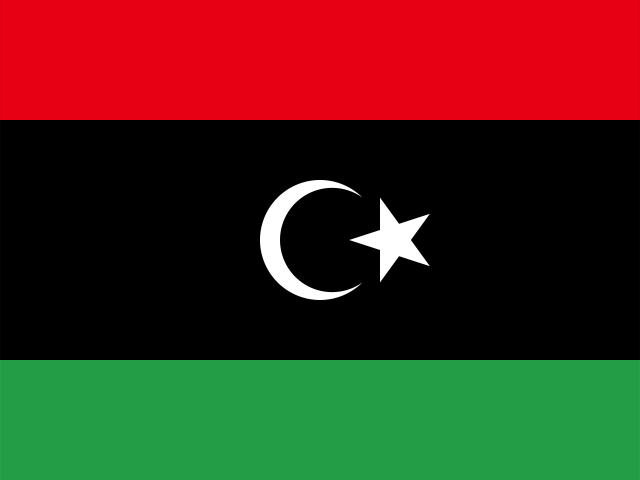
Libya📸 Photo album · 7 photos · Ultra-HD
Vast Roman cities by the sea and Saharan rock art
🕒 –:– local time1 stories this week1 sources 6 top placesCapital Tripoli
Long before the Sahara became a desert, Libya's interior was green savannah, and prehistoric peoples painted and carved giraffes, elephants and cattle on the rocks of the Acacus Mountains, now a UNESCO World Heritage Site. Berber (Amazigh) peoples have lived across North Africa for thousands of years, and in the Fezzan the Garamantes built a remarkable desert civilisation with underground irrigation channels and trading towns.
On the coast, Phoenician traders founded Oea (today's Tripoli), Sabratha and Leptis Magna, while Greeks settled Cyrene in the east, which became a famous centre of learning. Rome later absorbed the region, and Leptis Magna flourished as the hometown of Emperor Septimius Severus, who adorned it with grand monuments. After Roman and Byzantine rule, Arab armies arrived in the seventh century, bringing Islam and the Arabic language, which blended with Berber traditions over the following centuries.
From the sixteenth century, Tripoli came under Ottoman rule, though local Karamanli rulers governed with considerable independence for over a century. Italy invaded in 1911 and ruled Libya as a colony, facing long resistance, most famously from Omar al-Mukhtar in Cyrenaica. After fierce fighting during the Second World War, Libya became an independent kingdom under King Idris in 1951. The discovery of oil soon transformed the economy.
In 1969 Muammar Gaddafi took power and ruled for more than four decades, until his government was overthrown in 2011. Since then the country has experienced conflict, division and instability, and travel has been severely limited. Libya's heritage remains extraordinary: Leptis Magna and Sabratha are among the best-preserved Roman cities anywhere, Cyrene's ruins overlook the Mediterranean, and the old town of Ghadames is a masterpiece of desert architecture. Anyone considering a visit should first check their government's latest travel advice.
Entry rules depend on your passport and change often.
Before you book, check the official rules for your passport:
The latest visa and entry news for Libya appears below as soon as publishers report it.
Do not travel to Libya for any reason due to crime , terrorism , health concerns , unrest , kidnapping , or landmines . Read entire Travel Advisory. Do not travel to Libya for any reason. Restrictions on U.S. Government Personnel…
#Libya#United States#Travel advisory#Visas & Entry RulesLibya's coast has a Mediterranean climate with hot, dry summers and mild, slightly rainy winters. Inland, the Sahara is extremely hot by day in summer and can be cold at night in winter.
Typical daytime highs and rain in Tripoli (approximate averages).
Day 1-2: Tripoli's medina, castle and museums. Day 3: Leptis Magna. Day 4: Sabratha. Day 5: return to Tripoli for the souks. Only travel with an authorised local operator and after checking official advice.
Day 1-4: Tripoli, Leptis Magna and Sabratha. Day 5-6: Ghadames old town. Day 7-10: if conditions and official advice allow, an organised desert expedition to the Ubari lakes and Acacus rock art.
Backpacker budget: about $40–70 a day
Emergency: 1515 police · 193 ambulance
International flights, mainly via Tunisia, Turkey and other regional hubs, serve Mitiga airport in Tripoli and Benina in Benghazi, though routes change often. Land borders with Tunisia and Egypt exist but may be closed or restricted.
✈️ Cheap flights to Libya: airports, flight times & best time to fly →
Libya is considered dangerous due to ongoing conflict and instability, and most governments advise against all travel. Check your government's latest travel advice before making any plans.
Visits are possible only in limited circumstances, usually through authorised tour operators, and rules change frequently. Always check official advice and entry requirements first.
It depends on your passport – check the official government site or embassy before you travel, as requirements change frequently.
October to April is best, with mild coastal weather and cooler desert temperatures. Summer is very hot.
The Roman cities of Leptis Magna and Sabratha, the Greek ruins of Cyrene and the oasis town of Ghadames are the highlights. The Sahara holds rock art and dune lakes.
Approximate daily cost per person (stay, food, local transport).
Domestic flights connect the main cities, and long-distance roads link the coast. Desert trips are made with local guides and 4x4s.
Nothing in this tab yet – the agents add new stories every few minutes.
🌏 You reached the start of our archive.
_02_ies.jpg/500px-Malta_-_Mdina_(Triq_San_Oswald)_02_ies.jpg)
 MaltaGolden-stone cities, ancient temples and turquoise bays
 TunisiaRoman ruins, Saharan oases and Mediterranean beaches
 ChadSahara arches, desert lakes and a reborn wildlife park

 EgyptPyramids, pharaohs' tombs and Red Sea reefs
 NigerSahara mountains, Tuareg culture and desert cities

 GreeceAncient ruins, whitewashed islands and endless blue sea
 AlgeriaRoman ruins, Saharan oases and a white-walled Mediterranean capital
.jpg/500px-Ksamil_Albania_-_panoramio_(8).jpg)
 AlbaniaRiviera beaches, Ottoman towns and wild mountains