

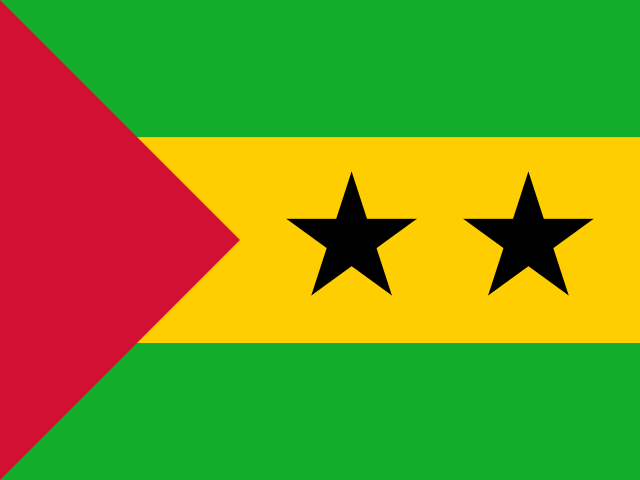
Sao Tome and Principe📸 Photo album · 3 photos · Ultra-HD
Chocolate islands on the equator, wild and green
🕒 –:– local time1 stories this week1 sources 4 top placesCapital São Tomé
São Tomé and Príncipe are volcanic islands in the Gulf of Guinea that were uninhabited when Portuguese navigators arrived around 1470. Within a few decades Portugal began settling the islands, bringing settlers, deportees and enslaved people from the African mainland. Thanks to fertile volcanic soil, São Tomé became one of the world's leading sugar producers in the sixteenth century, built on the labour of enslaved Africans.
Resistance was strong: in 1595 an enslaved man named Amador led a major revolt and is now celebrated as a national hero. As sugar production moved to Brazil, the islands became an important stopover in the Atlantic slave trade. In the nineteenth century coffee and then cocoa transformed the economy, and huge plantations called roças were built, each with its own hospital, workers' housing and railway lines. By the early twentieth century the islands were among the world's largest cocoa exporters, though conditions for contracted labourers drew international criticism.
Tensions under colonial rule culminated in the Batepá events of February 1953, when Portuguese authorities violently repressed local people, a moment commemorated each year. Independence came on 12 July 1975, followed by a period of single-party rule. Multiparty democracy was introduced in the early 1990s, and the country has since been known for peaceful transfers of power.
Today São Tomé and Príncipe is one of Africa's smallest and most tranquil countries. Visitors explore crumbling colonial roças, rainforest-clad volcanic peaks, empty golden beaches and the UNESCO Biosphere Reserve of Príncipe. The local Creole cultures, traditional tchiloli theatre and excellent cocoa and coffee make for a slow, rewarding journey.
Entry rules depend on your passport and change often.
Before you book, check the official rules for your passport:
The latest visa and entry news for Sao Tome and Principe appears below as soon as publishers report it.
Exercise increased caution in Sao Tome and Principe due to health risks. U.S. government employee travel restrictions As of August 12, 2026, U.S. government employees working for the U.S. Mission to Angola and Sao Tome and…
#Sao Tome and Principe#United States#Príncipe#Visas & Entry RulesThe islands are warm and humid year-round with tropical temperatures. The south and the mountains are much wetter than the drier north of São Tomé.
Typical daytime highs and rain in São Tomé (approximate averages).
Day 1 explore São Tomé city. Day 2 Monte Café and Obô Natural Park. Day 3-4 head south for Pico Cão Grande and Ilhéu das Rolas. Day 5 relax on the beaches.
Days 1-5 São Tomé with roças, rainforest hikes and the south coast. Days 6-10 fly to Príncipe for beaches, forest walks and quiet village life.
Backpacker budget: about $45–70 a day
Emergency:
São Tomé International Airport receives a limited number of flights, mainly via Lisbon and nearby African hubs. Príncipe is reached by short domestic flights or occasional boats.
✈️ Cheap flights to Sao Tome and Principe: airports, flight times & best time to fly →
Yes, the islands are considered peaceful and generally safe. Take normal precautions with belongings and health, especially against malaria.
June to September is the driest and most comfortable season. December to February is another good window, especially for turtle watching.
Five days covers São Tomé's highlights. Ten days lets you add Príncipe.
It depends on your passport – many nationalities can visit without a visa for short stays, but rules vary. Check the official government site or embassy before you travel.
Portuguese is the official language, with local Creoles widely spoken. English and French are spoken by some in the tourism industry.
Approximate daily cost per person (stay, food, local transport).
Taxis, shared minibuses and rental cars work on São Tomé; small planes and boats link to Príncipe.
Nothing in this tab yet – the agents add new stories every few minutes.
🌏 You reached the start of our archive.
.jpg/500px-Nationalpark_Monte_Al%C3%A9n_(Tafel).jpg)
 Equatorial GuineaVolcanic Bioko island, rainforest and sea-turtle beaches
 GabonRainforest parks where elephants walk on the beach
 NigeriaBig-city energy, Afrobeats and lush highlands
 Cameroon'Africa in miniature' – volcano, rainforest, beaches and kingdoms
 Republic of the CongoRainforest gorillas, the Congo River and Brazzaville
_(2).jpg/500px-Ganvi%C3%A9_fishing_village_on_stilts_in_Benin_(10282059623)_(2).jpg)
 BeninBirthplace of Vodun, royal palaces and a village on stilts
 TogoPalm beaches, green hills and colourful markets
 GhanaCastles, rainforest canopy walks and vibrant Accra