

.jpg/1920px-%D0%9C%D0%9E%D0%9D%D0%90%D0%9A%D0%9E_-_panoramio_(4).jpg)

Monaco📸 Photo album · 5 photos · Ultra-HD
Glamorous casinos, superyachts and Riviera sunshine
🕒 –:– local time1 stories this week1 sources 4 top placesCapital Monaco
Squeezed between the mountains and the Mediterranean, Monaco's rocky coastline has sheltered people since prehistoric times, and caves beneath today's Exotic Garden have revealed traces of early human life. In antiquity Ligurian tribes lived here, and Greek sailors linked the natural harbour to the hero Hercules, calling it Monoikos – the origin of the name Monaco. The Romans later knew the harbour as Portus Herculis Monoeci.
In 1215 the Republic of Genoa built a fortress on the Rock. Then, in 1297, according to tradition, François Grimaldi disguised himself as a Franciscan monk, was let inside the gates and seized the fortress with his men. Two monks with raised swords still appear on Monaco's coat of arms, and, after many struggles, the Grimaldi family went on to rule for more than 700 years, making it one of the oldest reigning dynasties in Europe.
Monaco passed between Spanish and French protection, was annexed by revolutionary France in 1793 and was restored to the Grimaldis in 1814. In the mid-19th century it lost the towns of Menton and Roquebrune, which made up most of its territory, and was left with little income. Prince Charles III's solution was a casino: the district around it was named Monte Carlo in his honour, and the arrival of the railway turned it into a glittering resort for Europe's elite. Prince Albert I, a pioneering oceanographer, founded the Oceanographic Museum, while Prince Rainier III's 1956 marriage to Hollywood star Grace Kelly brought worldwide glamour. Monaco joined the United Nations in 1993, and Prince Albert II has reigned since 2005.
For visitors, this tiny principality packs in a remarkable amount: the medieval lanes of Monaco-Ville, the Prince's Palace and its changing of the guard, belle époque architecture in Monte Carlo, world-famous motor racing and some of the most dramatic coastal scenery on the Riviera.
Entry rules depend on your passport and change often.
Before you book, check the official rules for your passport:
The latest visa and entry news for Monaco appears below as soon as publishers report it.
Private chauffeur services from Nice Airport provide pre-arranged transfers and flexible transport to Monaco, Cannes, Antibes, Saint-Tropez and other French Riviera destinations. The article Private Chauffeur Services on the…
 #France#Monaco#Flights & Airlines
Monaco enjoys a sunny Mediterranean climate with hot, dry summers and mild, slightly wetter winters. Being sheltered by mountains, it is one of the warmer spots on the French Riviera year-round.
Typical daytime highs and rain in Monaco (approximate averages).
Day 1 explore Monaco-Ville, the changing of the guard, the cathedral and the Oceanographic Museum, ending at Port Hercule. Day 2 visit the Exotic Garden, the Japanese Garden and Casino Square, then relax at Larvotto Beach.
Day 1-2 see Monaco's highlights, then Day 3 walk the coastal path to Cap-d'Ail or visit hilltop Èze. Day 4 take the train to Menton for its gardens and old town, and Day 5 explore Nice or Villefranche-sur-Mer.
Backpacker budget: about $120–170 a day
Emergency: 112 general · 17 police · 18 fire & ambulance
The nearest airport is Nice Côte d'Azur in France, with buses, trains and helicopter transfers to Monaco. Monaco's station lies on the scenic coastal railway linking Nice, Menton and Italy.
✈️ Cheap flights to Monaco: airports, flight times & best time to fly →
Monaco is one of the safest places in Europe, with very low crime and a strong police presence. Just watch for pickpockets on busy trains from Nice.
Late spring and September offer warm weather with fewer crowds. Visit in May for the Grand Prix, but book well ahead.
One full day is enough to see Monaco's main sights. Two days lets you enjoy them at a relaxed pace, and many visitors combine Monaco with Nice and the Riviera.
Monaco is not in the EU but has an open border with France, so entry generally follows French rules. Requirements depend on your passport – check official government sources before you travel.
Yes, Monaco is one of the most expensive destinations in the world. Staying in Nice or Menton, picnicking and enjoying free sights keeps a visit affordable.
Approximate daily cost per person (stay, food, local transport).
Monaco is easy to walk, helped by public lifts and escalators. Buses cross the city and trains link it with Nice and nearby towns.
Nothing in this tab yet – the agents add new stories every few minutes.
🌏 You reached the start of our archive.
.jpg/500px-Lucerne,_Switzerland_-_panoramio_(4).jpg)
 SwitzerlandSnowy Alps, lakeside towns and trains that run on time
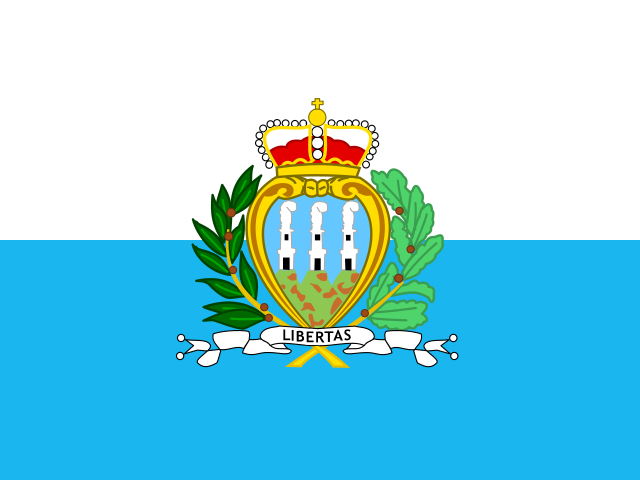 San MarinoTiny hilltop republic with medieval towers and big views
.jpg/500px-Malbun_seen_from_Augstenberg_(valo139).jpg)
 LiechtensteinA tiny Alpine principality of castles, vineyards and trails
 Vatican CityThe world's smallest country and the heart of Catholicism

 ItalyAncient Rome, Renaissance art and the world's favourite food
 AndorraTiny Pyrenees country of ski slopes and mountain trails
 FranceIconic Paris, châteaux, vineyards and sunny Riviera beaches
 CroatiaIsland-hopping, walled cities and crystal-clear sea