.jpg/1920px-Church_of_the_Nativity_(7703592746).jpg)


_P177_Hebron_Old_City.jpg/1920px-Holy_Land_2022_(1)_P177_Hebron_Old_City.jpg)


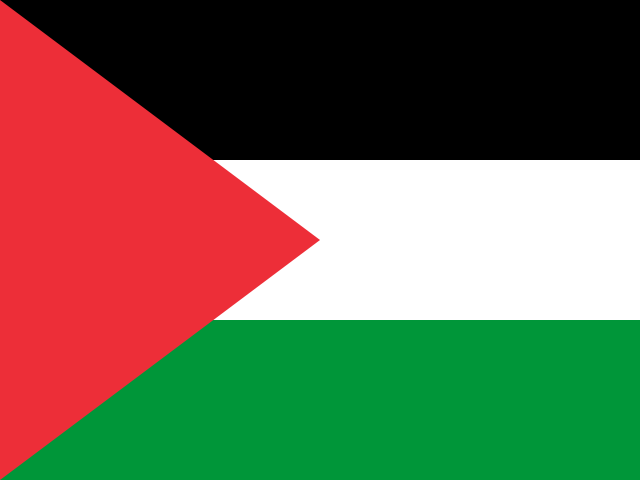
Palestine📸 Photo album · 9 photos · Ultra-HD
Ancient towns, olive groves and deep-rooted traditions
🕒 –:– local time3 stories this week2 sources 6 top placesCapital Ramallah
The land of Palestine has one of the longest records of human settlement on Earth. Jericho, set in an oasis near the Dead Sea, is often described as one of the oldest continuously inhabited towns in the world, with a stone tower built more than ten thousand years ago. Over the millennia Canaanites, Philistines, Israelites and others lived in the region, and the name Palestine itself is linked to the ancient Philistines of the coast. Successive empires, including the Egyptians, Assyrians, Babylonians, Persians and Greeks, ruled the area in turn.
Under the Romans and later the Byzantines, the region became central to Christianity, with churches built over sites associated with the life of Jesus, such as the Church of the Nativity in Bethlehem. Arab armies brought Islam in the seventh century, and Arabic gradually became the main language. Crusaders, Ayyubids and Mamluks fought over and governed the land in the Middle Ages, and the Ottoman Empire ruled it from 1516 for four centuries, leaving markets, caravanserais and mosques in towns such as Nablus and Hebron.
After the First World War, Britain administered Palestine under a League of Nations mandate. The end of the mandate in 1948 brought war and the establishment of the State of Israel, and many Palestinians were displaced. In 1967 the West Bank, East Jerusalem and Gaza came under Israeli control. The Oslo Accords of the 1990s created the Palestinian Authority, and the State of Palestine is recognised by many countries; the region's status remains at the centre of a long-running conflict.
For visitors, the West Bank holds some of the world's most important religious and historic sites, alongside olive groves, desert monasteries and lively markets. Palestinian culture is known for its embroidery, music and dabke dancing, and for dishes such as musakhan, maqluba and Nablus's famous knafeh. Security conditions vary and can change quickly, so checking official advice is essential.
Entry rules depend on your passport and change often.
Before you book, check the official rules for your passport:
The latest visa and entry news for Palestine appears below as soon as publishers report it.
Reissued Statement There were no changes to the Travel Advisory Level. The health risk indicator was added for Gaza. Advisory summary was updated to reflect that family members may travel to Israel. Reconsider Travel to Israel…
#Israel#Palestine#Travel advisory#Visas & Entry RulesReconsider Travel to West Bank due to terrorism and unrest . Advisory summary U.S. government employee travel restrictions U.S. government employees working in Israel must obtain special authorization for official travel to the…
#Palestine#United States#Visas & Entry RulesDo Not Travel to Gaza due to terrorism, unrest, and limited health infrastructure . Advisory Summary: Restrictions on U.S. Government Personnel Movement U.S. government employees are prohibited from traveling to Gaza for any…
#Palestine#United States#Visas & Entry RulesAnyone traveling from Israel to Amsterdam faces the risk of having their bags searched on arrival for goods that were produced in illegal Israeli settlements in the West Bank after the Dutch government introduced new laws that…
 #Netherlands#Israel#Amsterdam#Flights & Airlines
The region has a Mediterranean climate with hot, dry summers and mild, rainy winters. Jericho and the Jordan Valley are much hotter, while the highlands can see occasional snow.
Typical daytime highs and rain in Bethlehem (approximate averages).
Only if official advice permits: Day 1 Bethlehem's Church of the Nativity and old town. Day 2 Jericho, Hisham's Palace and the Monastery of the Temptation. Day 3 hike Wadi Qelt or visit Battir.
Only if official advice permits: Days 1-2 Bethlehem and Battir. Day 3 Hebron with a guide. Days 4-5 Jericho and Wadi Qelt. Days 6-7 Ramallah, Nablus and Sebastia.
Backpacker budget: about $35–55 a day
Emergency: 100 police · 101 ambulance · 102 fire
There is no functioning airport; most travellers enter the West Bank via Israel or across the Allenby/King Hussein Bridge from Jordan. Entry rules and crossings can change, so check before you go.
✈️ Cheap flights to Palestine: airports, flight times & best time to fly →
Gaza is not accessible to most visitors and travel there is strongly advised against. Conditions in the West Bank vary and can change quickly, so check your government's latest travel advice before planning a trip.
Spring and autumn offer the most comfortable weather. Christmas is a special time to visit Bethlehem, if conditions allow.
Most visitors enter through Israel or via the Allenby/King Hussein Bridge from Jordan. Rules and opening hours can change, so check before travelling.
Entry depends on your passport and on which crossing you use. Check the official government site or embassy before you travel.
The Israeli new shekel is the main currency, with Jordanian dinars and US dollars sometimes accepted. Carry some cash, as cards are not accepted everywhere.
Approximate daily cost per person (stay, food, local transport).
Shared taxis called servees and minibuses connect towns cheaply. Allow extra time for journeys between cities.
Nothing in this tab yet – the agents add new stories every few minutes.
🌏 You reached the start of our archive.

 IsraelBeach cities, desert fortresses and the salty Dead Sea

 JordanRose-red Petra, desert camps and the Dead Sea
 LebanonAncient ruins, mountain cedars and Mediterranean food
 CyprusSunny Mediterranean island of myths, mosaics and meze
 SyriaAncient cities, Crusader castles and old souqs

 EgyptPyramids, pharaohs' tombs and Red Sea reefs

 TürkiyeWhere Europe meets Asia – bazaars, beaches and balloons
 IraqCradle of civilisation, holy cities and ancient Mesopotamia